What is a Laser?
Light is one of the most familiar phenomena in nature, yet the light produced by a laser is fundamentally different from the light emitted by ordinary sources such as light bulbs, flames, LEDs, or even the Sun. While conventional light sources generate photons that travel in many directions and possess a wide range of wavelengths and phases, laser light is highly organized. It emerges as a narrow beam, consists of nearly a single wavelength, and maintains a fixed phase relationship among its photons. These properties are known as directionality, monochromaticity, and coherence, respectively, and together they make lasers uniquely powerful tools in science and technology.
To understand why laser light possesses these remarkable characteristics, we must first examine how atoms interact with electromagnetic radiation.
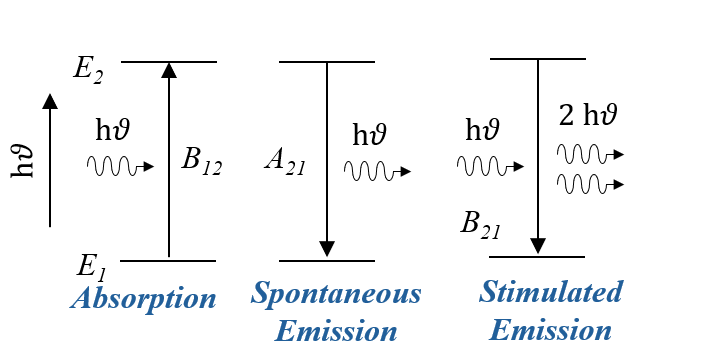
The interaction between matter and radiation can occur through three fundamental processes, first described quantitatively by Albert Einstein in 1917: absorption, spontaneous emission, and stimulated emission.
In absorption, an atom initially residing in the lower energy state E1 captures a photon whose energy matches the energy gap between the two states. The energy of the photon is transferred to the electron, causing it to move into the excited state E2. The probability of this process occurring is described by Einstein's absorption coefficient B12. The rate of absorption depends not only on this coefficient but also on the intensity of the radiation field and the number of atoms available in the lower state. The stronger the incoming radiation and the larger the ground-state population, the more rapidly absorption takes place.
Once an electron has been promoted to an excited state, it cannot remain there indefinitely. Eventually it returns to a lower energy level. One way this can happen is through spontaneous emission. In this process, the excited atom undergoes a transition to a lower state without any external influence, releasing a photon whose energy equals the energy difference between the two states. Einstein described this process using the coefficient A21, which represents the probability per unit time that an excited atom will decay spontaneously.
Although spontaneous emission generates light, the photons it produces are completely random. Each emitted photon may travel in a different direction, possess a different phase relationship relative to other photons, and have a random polarization. Consequently, the light produced through spontaneous emission is incoherent. Ordinary light sources such as incandescent bulbs, fluorescent lamps, and the Sun derive much of their radiation from enormous numbers of spontaneous emission events occurring independently throughout the material.
The third process, stimulated emission, is the key to understanding lasers. Suppose an atom is already in the excited state E2. If a photon of the correct energy passes nearby, it can interact with the excited atom in a very special way. Rather than being absorbed, the incoming photon induces the atom to return to the lower state. During this transition, the atom emits a second photon.
What makes stimulated emission extraordinary is that the emitted photon is not random. It is an exact replica of the incident photon. The new photon has precisely the same frequency, travels in exactly the same direction, possesses the same polarization, and oscillates in phase with the incoming photon. After the interaction, two identical photons continue on together. These photons can stimulate additional excited atoms, producing still more identical photons. The result is a chain reaction that amplifies light while preserving its order.
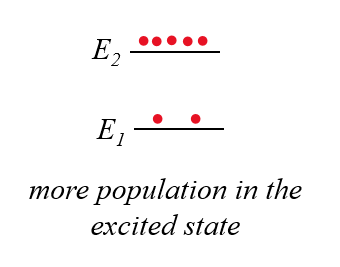
Despite the power of stimulated emission, it does not automatically produce a laser. Under normal conditions, most atoms occupy their lowest energy state. If light enters such a system, absorption generally dominates because there are far more atoms available to absorb photons than there are excited atoms available to emit them. The medium therefore attenuates light rather than amplifying it. For amplification to occur, the situation must be reversed. There must be more atoms in the excited state than in the lower state.
This condition is called population inversion. Population inversion represents a highly non-equilibrium situation that does not occur naturally in thermal systems. When a population inversion is achieved, an incoming photon is more likely to stimulate the emission of another photon than to be absorbed. Under these circumstances, light amplification becomes possible. Achieving population inversion requires an external energy source, a process known as pumping. Energy may be supplied by electrical current, intense light from a flash lamp, chemical reactions, or even another laser. The pumping mechanism continually transfers atoms into excited states, maintaining the inversion necessary for laser operation.
Population inversion alone is still not sufficient to produce the familiar laser beam. The emitted photons must be repeatedly amplified. This is accomplished using an optical cavity, sometimes called a laser resonator. The cavity typically consists of two mirrors positioned at opposite ends of the gain medium. One mirror reflects nearly all incident light, while the other allows a small fraction of the light to escape.
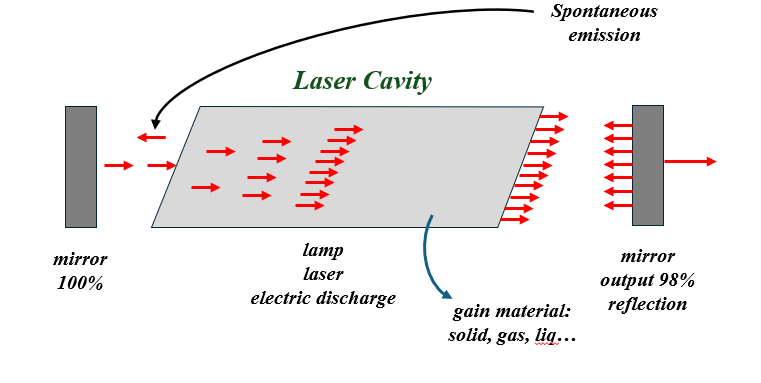
As photons travel through the gain medium, they stimulate the emission of additional photons. The mirrors reflect these photons back and forth through the medium many times, causing repeated amplification. Photons traveling along directions aligned with the cavity survive and continue to build in intensity, whereas photons traveling in other directions are lost. This selective amplification forces the output to become highly directional.
At the same time, because every stimulated emission event produces photons that are phase-matched to those already present, the light remains coherent. Since all emitted photons originate from essentially the same atomic transition, the beam is also highly monochromatic. The optical cavity therefore reinforces the three defining characteristics of laser light: coherence, monochromaticity, and directionality.
Modern lasers exist in many forms, including gas lasers, solid-state lasers, fiber lasers, and semiconductor lasers. Among the most common are diode lasers, which operate within semiconductor p-n junctions. When an electrical current passes through the junction, electrons and holes recombine, producing photons. Under conditions of population inversion, stimulated emission amplifies these photons. The polished semiconductor surfaces naturally form a resonant cavity, allowing coherent laser light to emerge. Because diode lasers are compact, efficient, and inexpensive, they are found in telecommunications systems, barcode scanners, laser pointers, medical instruments, and Raman spectroscopy systems.
Ultimately, a laser is much more than a bright light source. It is a device that uses stimulated emission, population inversion, and optical feedback to transform random atomic emissions into an intensely organized beam of light. The extraordinary degree of order within laser light is what makes lasers indispensable in modern science, medicine, engineering, and analytical chemistry.