
Integrated Solutions for Complex Needs
Raman Spectroscopy: Probing Molecular Vibrations Through Light Scattering
Raman spectroscopy is a powerful analytical technique that provides molecular information by measuring how light scatters from a sample. Like infrared (IR) spectroscopy, Raman spectroscopy probes molecular vibrations and can be used to identify compounds, characterize materials, and study chemical changes. However, while IR spectroscopy measures the absorption of infrared radiation, Raman spectroscopy measures the small changes in energy that occur when light is scattered by molecules.
The technique is based on the interaction between the electric field of a laser and the electron cloud of a molecule. When laser light strikes a molecule, the oscillating electric field of the light distorts the molecule's electron cloud, temporarily polarizing it. Most of the incident photons scatter without changing energy, but a very small fraction exchange energy with molecular vibrations. These tiny energy shifts form the basis of Raman spectroscopy and provide a molecular fingerprint of the sample.
How Raman Scattering Occurs
Imagine shining a laser beam onto a molecule. The electric field of the laser pushes and pulls on the molecule's electron cloud, much like jiggling a soft piece of jelly. The photon is not typically absorbed by the molecule. Instead, it interacts briefly with the distorted electron cloud and is scattered.
During this interaction, the molecule may exchange a small amount of vibrational energy with the photon. Depending on what happens during this "collision," several outcomes are possible.
Rayleigh Scattering
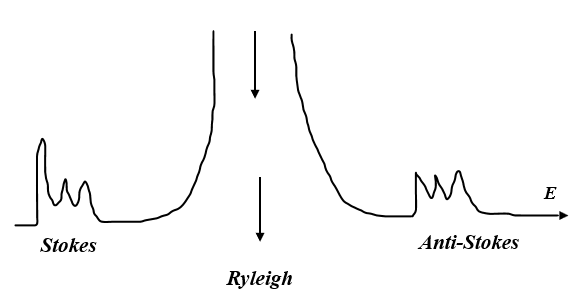
In most cases, no energy is exchanged between the photon and the molecule. The photon simply changes direction and leaves with the same energy it had before the interaction. This process is known as Rayleigh scattering and accounts for more than 99.9% of all scattered photons.
Because the scattered photon has the same energy and wavelength as the incident photon, Rayleigh scattering is considered elastic scattering.
Stokes Raman Scattering
If the photon transfers some of its energy to the molecule, the molecule is left in a higher vibrational state. Since energy must be conserved, the scattered photon leaves with slightly less energy than it originally possessed.
The scattered light therefore has:
Lower frequency
Longer wavelength
Lower energy
This process is called Stokes Raman scattering.
Since most molecules are initially in their vibrational ground state at room temperature, Stokes scattering is usually stronger than anti-Stokes scattering and is therefore the signal most commonly measured in Raman spectroscopy.
Anti-Stokes Raman Scattering
Occasionally, a molecule is already vibrating before the photon arrives. In this case, the molecule can transfer some of its vibrational energy to the incoming photon.
The scattered photon leaves with:
Higher frequency
Shorter wavelength
Higher energy
This process is known as anti-Stokes Raman scattering.
Because relatively few molecules occupy excited vibrational states at room temperature, anti-Stokes signals are generally weaker than Stokes signals.
The Virtual State Concept
To understand Raman scattering more deeply, it is useful to consider an energy-level diagram.
In normal Raman spectroscopy, the incoming laser photon does not possess sufficient energy to populate a real electronic excited state. Instead, the electric field of the photon temporarily distorts the electron cloud into what is called a virtual state.
A virtual state is not a true molecular energy level. It exists only during the extremely brief interaction between the incoming photon and the molecule.
An analogy is pushing a tennis ball against a trampoline. The ball briefly deforms the trampoline surface and immediately rebounds without settling into a new position. Similarly, the photon temporarily distorts the molecule's electron cloud, creating a virtual state before scattering occurs.
Because the process passes through a virtual state rather than a real electronic state, Raman scattering occurs extremely quickly, often within femtoseconds.
Raman Shift
Rather than reporting the wavelength of the scattered light directly, Raman spectra are typically displayed as a Raman shift in units of cm⁻¹.
The Raman shift represents the energy difference between the incident laser light and the scattered light.
For Stokes scattering:
ωs=ω0−ωv\omega_s = \omega_0 - \omega_vωs=ω0−ωv
For anti-Stokes scattering:
ωs=ω0+ωv\omega_s = \omega_0 + \omega_vωs=ω0+ωv
where:
ω0\omega_0ω0 = frequency of the laser
ωv\omega_vωv = vibrational frequency of the molecule
ωs\omega_sωs = frequency of the scattered light
These shifts correspond directly to molecular vibrations and serve as a molecular fingerprint.
Raman Selection Rule
The Raman selection rule differs fundamentally from the IR selection rule.
For a vibration to appear in an IR spectrum, it must produce a change in dipole moment.
For a vibration to appear in a Raman spectrum, it must produce a change in polarizability.
What is Polarizability?
Polarizability describes how easily a molecule's electron cloud can be distorted by an external electric field.
As atoms vibrate, the size, shape, or distribution of the electron cloud may change. If this vibration changes the molecule's polarizability, that vibration becomes Raman active.
Simple Rule
A molecular vibration is Raman active if it produces a change in polarizability during the vibration.
No change in polarizability means no Raman signal.
Because Raman and IR spectroscopy use different selection rules, the two techniques are highly complementary. Vibrations that are weak or absent in IR are often strong in Raman spectroscopy and vice versa.
Why Raman Signals Are Weak
Although Raman spectroscopy is extremely informative, it is inherently a weak process.
Only about one in every million to one hundred million photons undergoes Raman scattering. The vast majority undergo Rayleigh scattering instead.
For this reason, Raman spectroscopy relies on intense laser sources, sensitive detectors, and sophisticated optical systems to collect meaningful signals.
Fortunately, several specialized Raman techniques can dramatically increase signal intensity.