Surface-Enhanced Raman Spectroscopy (SERS)
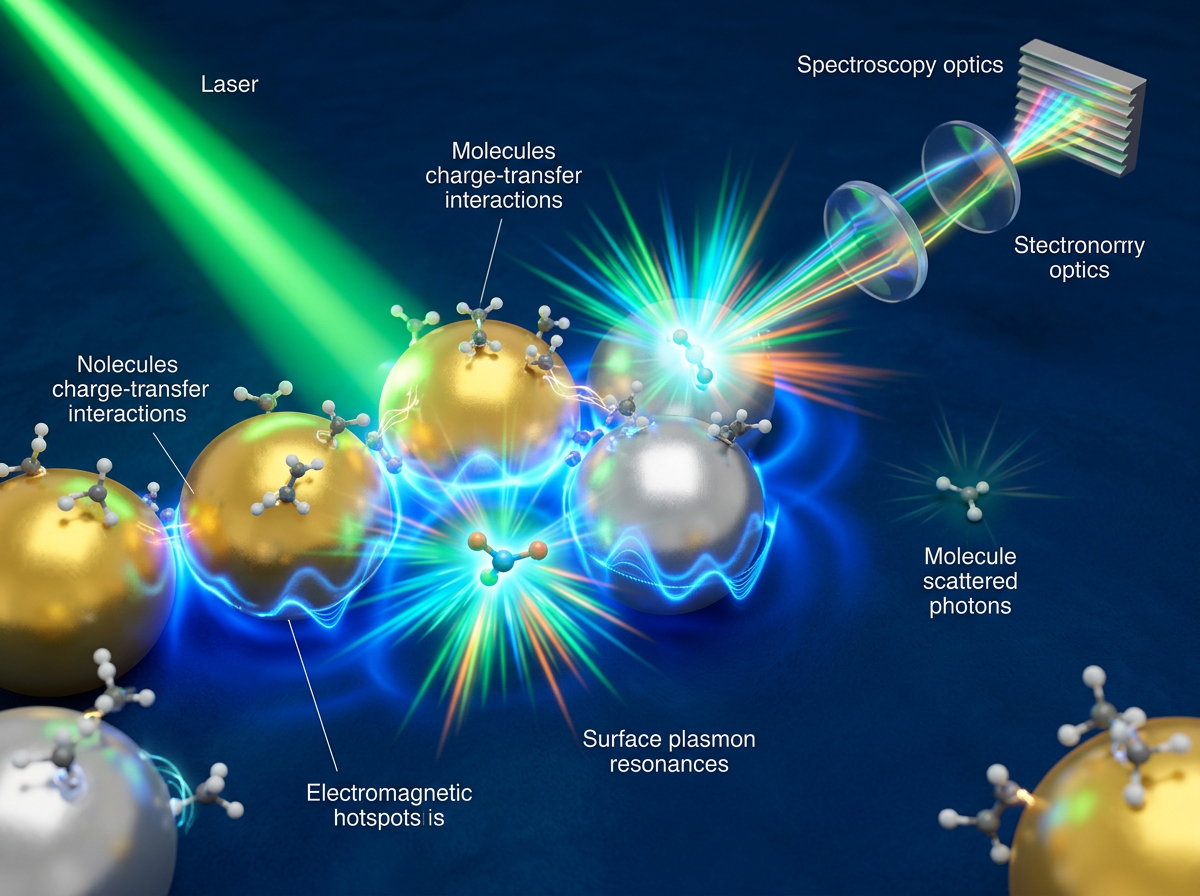
One of the most dramatic advances in Raman spectroscopy is Surface-Enhanced Raman Scattering (SERS). SERS overcomes the natural weakness of Raman scattering by placing molecules on or near specially engineered metal nanostructures. Common SERS substrates include:
Gold (Au)
Silver (Ag)
Copper (Cu)
When molecules are adsorbed onto these metallic surfaces, Raman signals can increase dramatically. Enhancement factors commonly range from 1 million to 10 billion, and in exceptional cases, signals can be strong enough for single-molecule detection.
Electromagnetic Enhancement
The primary source of SERS enhancement is the electromagnetic effect. When laser light strikes a metallic nanoparticle, the conduction electrons within the metal oscillate collectively. These oscillations are known as surface plasmons. At certain frequencies, the plasmons resonate with the incoming light, creating extremely intense localized electric fields near the metal surface. These regions are called hot spots. Molecules located inside these hot spots experience electric fields many orders of magnitude stronger than the incident laser field. Since Raman scattering intensity depends strongly on the electric field strength, the resulting Raman signal becomes dramatically amplified.
Chemical Enhancement
A second, smaller enhancement mechanism is known as chemical enhancement. When a molecule interacts directly with a metal surface, electronic coupling and charge transfer can occur between the molecule and the metal. This interaction modifies the electronic structure and polarizability of the molecule, increasing the efficiency of Raman scattering. Although typically smaller than the electromagnetic effect, chemical enhancement provides additional signal amplification and contributes to the extraordinary sensitivity of SERS.
Why Raman Spectroscopy Is Important
Raman spectroscopy provides a unique way to probe molecular structure by measuring the inelastic scattering of laser light. Unlike IR spectroscopy, which requires a change in dipole moment, Raman spectroscopy is sensitive to changes in molecular polarizability. This makes the two techniques highly complementary and often used together.
Modern Raman methods such as Resonance Raman and SERS have transformed what is naturally a weak scattering process into an extraordinarily powerful analytical tool. Today Raman spectroscopy is used in chemistry, pharmaceuticals, materials science, semiconductor research, environmental monitoring, forensics, art conservation, and biomedical diagnostics.
At its core, Raman spectroscopy is remarkably elegant: a laser photon briefly interacts with a molecule, exchanges a tiny amount of energy with a vibration, and scatters away carrying information about the molecule's structure. By measuring these tiny energy shifts, scientists can reveal the molecular fingerprints hidden within matter.